
Applicant tracking system · Singapore

An applicant tracking system for Singapore hiring teams.

Bring roles, applications, interview feedback and hiring handoffs into one shared record. Start with a focused pilot for your Singapore hiring team.

At a glance

  • Publish roles through a public careers page
  • Keep candidate, application, source, and stage context together
  • Collect interview kits, scorecards, and team feedback
  • Carry selected candidates into offers and onboarding tasks

Current availability

Start free; Basic and Growth are coming soon

Free is available now for the core pipeline, with two operators, five concurrent jobs, and no credit card. Basic adds careers page publishing and the MCP connector; Growth adds the Hiring Manager and Candidate portals, candidate communications, and analytics. Both are coming soon. Validate your workflow before rollout.

From role to hire

One workflow, with the evidence attached.

A useful ATS should make the next action visible without separating the context that led to it. TiLab connects the operational steps around a candidate record so recruiters and hiring collaborators can work from the same information.

  1. Open the role

    Create the job and publish it to the organisation’s careers page so the role and incoming applications start in the same workspace.

  2. Capture applicants

    Keep the candidate profile, CV, application, and recorded source together instead of recreating the same person across separate sheets.

  3. Move the pipeline

    Track stage, owner, aging, notes, and the next action against the role-specific application as the process moves forward.

  4. Review consistently

    Use interview kits and scorecards to collect role-relevant feedback before the hiring team reaches a decision.

  5. Complete the handoff

    Keep offer progress, approvals, and onboarding status connected to the record rather than losing the final steps to email threads.

What stays connected

The records a hiring team checks every day.

The product concentrates on operational recruiting records. It does not need to invent a score or automate a decision to make the workflow easier to follow.

  • Jobs and public careers

    Manage the opening and the public application route from the same system used to review the resulting candidates.

  • Candidate and application context

    Store CVs, files, notes, source labels, contact history, and job-specific progress without flattening every application into one generic status.

  • Structured collaboration

    Give the team a focused place for shortlists, scorecards, interviewer feedback, ownership, and next actions.

  • Operational visibility

    Review pipeline movement, source records, stuck candidates, interview follow-up, and offer progress from data already captured in the ATS.

A realistic fit

What a Singapore team should check in a pilot.

A Singapore address in a page title does not make software right for a local team. The useful test is whether the product reflects how your recruiters, hiring managers, and candidates actually move through a role.

Use a local hiring scenario

A Singapore-based Customer Support Specialist role is a useful fictional pilot: it combines a public application, written evidence, a manager review, and a final decision.

  • Check that the public role displays the intended Singapore location and working arrangement
  • Confirm that interview times and invitations are clear to each participant
  • Apply the same communication and problem-solving criteria to each sample applicant
  • Reconstruct the decision from the job, feedback, and next-action records
Know the boundary

TiLab ATS is a hiring workflow product, not a substitute for a hiring policy or professional advice.

  • The hiring organisation remains responsible for its process and decisions
  • The product does not make the final hiring decision
  • A source label is not evidence of a direct MyCareersFuture or job-board integration
  • Confirm the required export, deletion, access, and support arrangements during evaluation

Common questions

What to establish before moving a live role.

Will an ATS publish directly to every Singapore job board?

Do not assume that. TiLab’s public careers route and recorded source labels are distinct from a direct job-board connection. If your process depends on MyCareersFuture or another board, ask the provider to demonstrate that exact connection and its availability before selecting the tool.

Is TiLab ATS only for Singapore companies?

No. The product supports general recruiting workflows. This page focuses on the needs of teams evaluating an ATS from Singapore, not on an exclusive country restriction.

Does it make hiring decisions for the team?

No. TiLab organises records, stages, feedback, and handoffs. Recruiters and hiring managers remain responsible for interpreting evidence and making decisions.

Can we test it against our current process?

Yes. Run the core pipeline in a free workspace, or use the contact route to discuss your roles, stages, scorecards, and collaborator model before setup.

A worked evaluation

A one-week pilot for a Singapore recruiting team.

This fictional example uses two recruiters, one hiring manager, a Customer Support Specialist opening, and three synthetic applicants. It tests the handoffs a team can observe directly.

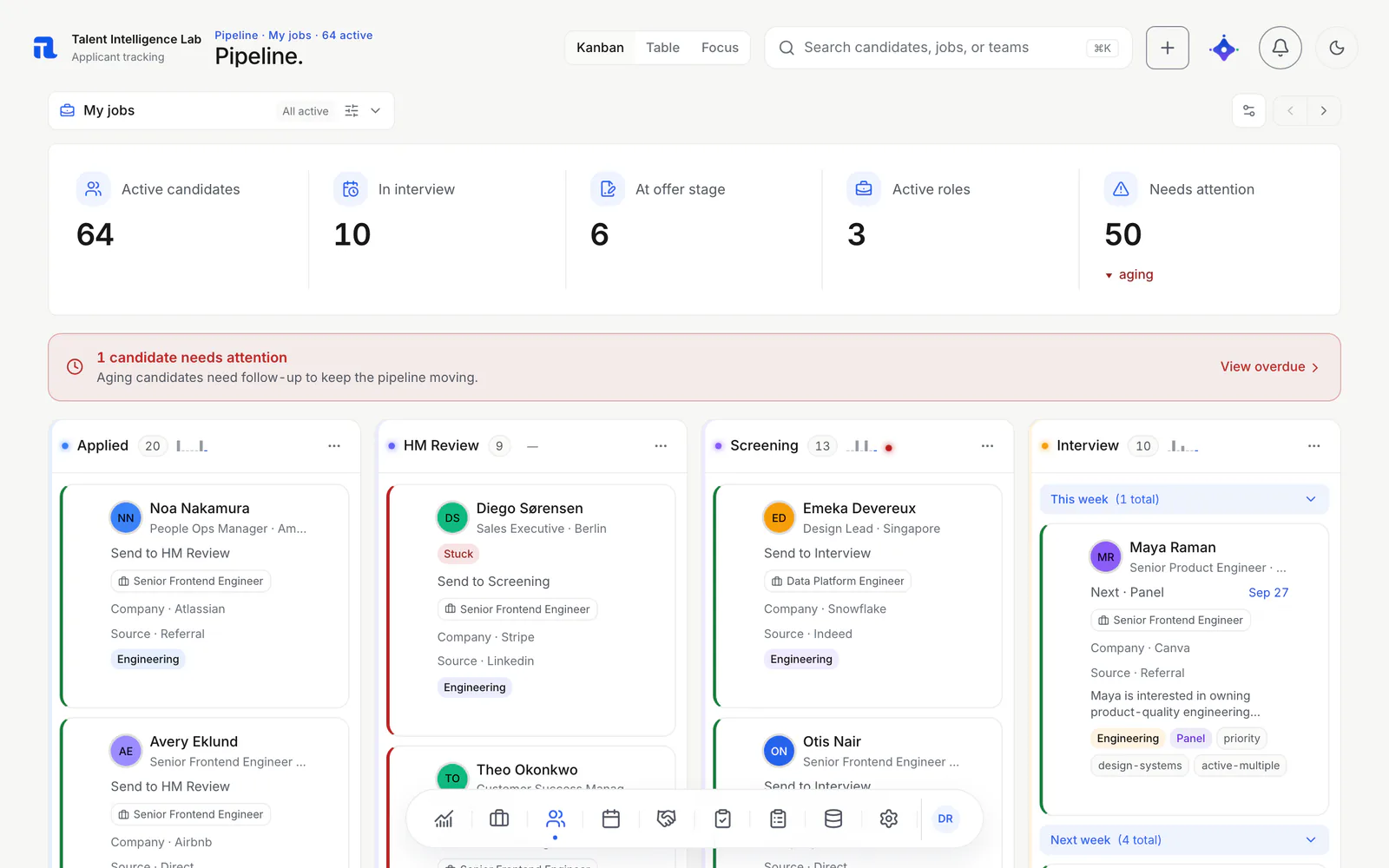
TiLab candidate pipeline in Kanban view, with Applied, HM Review, Screening and Interview columns of synthetic candidates.
TiLab pipeline, captured September 2026 from a synthetic demo workspace. Names, companies and totals are illustrative, not customer results.
  • Days 1–2: agree the evidence

    Write the role’s must-have requirements, expected working arrangement, and interview criteria. The two recruiters operate the workspace; agree how they will record the hiring manager’s feedback against the same criteria.

  • Days 3–4: run the sample

    Add the three synthetic applicants to the role, each clearly marked as a test. Check that every application has the correct job, source, and stage, then record sample feedback against the agreed criteria.

  • Day 5: reconstruct the decision

    Walk the hiring manager through the recorded evidence and ask the recruiters to identify the next action. Record missing capabilities and unanswered questions in the evaluation scorecard before choosing whether to expand.

A useful result is a completed application-to-decision record and a clear list of gaps. A Singapore-focused page or product demo alone does not establish that a system meets your operational or legal requirements.

Explore the workflow

Continue with a related guide.

Start with a current role and check whether TiLab gives your team a clearer shared record from application to decision. Compare the plans to find the right starting point.

Contact the team

Bring one real hiring workflow.

Get started