Focused shortlists and feedback for hiring collaborators
Interview kits and scorecards tied to the role
Offer progress and onboarding status after selection
Plans
Collaboration built into Growth
Admins and Recruiters operate the workspace on every plan. Growth, coming soon, adds the Hiring Manager and Candidate portals, candidate communications, and calendar scheduling, so the wider hiring team works from the same record.
Shared operating rhythm
Move the process without losing ownership.
The recruiter should be able to see what is next, while each collaborator gets enough context to act. The ATS record becomes the handoff point instead of asking the team to reconstruct decisions from meetings and messages.
01
Define the opening
Create the job and keep its requirements, ownership, and public careers route close to the resulting applicant pipeline.
02
Build the shortlist
Review candidate records, CVs, source context, notes, and job-specific applications before inviting wider feedback.
03
Focus collaborators
Give hiring managers and interviewers the relevant shortlist, interview context, and feedback task instead of the entire recruiting desk.
04
Record the decision
Collect scorecards and written feedback against the role so the decision trail stays with the candidate record.
05
Carry the result forward
Track approvals, offer progress, and onboarding status as the process moves from recruiting into the next internal handoff.
Team coordination
Recruiter control without collaborator sprawl.
TiLab separates the work that needs a recruiter’s full operating view from the focused contributions that hiring managers, interviewers, and approvers need to make.
Clear pipeline ownership
Keep stage, owner, next action, aging, and job-specific notes visible on the application so follow-up has an accountable home.
Focused decision input
Shortlists, interview kits, scorecards, and feedback requests provide a defined task rather than an open-ended search through candidate files.
Candidate continuity
The candidate profile, files, source record, applications, interviews, and contact history stay connected across more than one role or hiring cycle.
A durable handoff
Offers, approvals, onboarding status, and the activity trail remain connected to the recruiting record after a preferred candidate is identified.
Before adopting
Map the people as carefully as the stages.
A polished pipeline will not fix unclear ownership. Before moving a role, decide who controls the record, who supplies feedback, and what evidence must exist before the next stage.
Prepare these inputs
The strongest starting point is one real role with a known process and named collaborators.
Recruiter: application review, candidate communication, and next-action ownership
Hiring manager: role requirements, shortlist recommendations, and written rationale
Interviewer: evidence against agreed criteria, submitted by a team-defined deadline
Approver: the offer decision and the required internal handoff
Keep expectations grounded
TiLab makes the shared record easier to operate; it does not resolve organisational decisions by itself.
Managers still need to provide timely, useful feedback
Recruiters still own candidate communication and process quality
Scorecards support judgment rather than replacing it
Choose the plan that matches who needs access; the Hiring Manager portal is part of Growth
Common questions
How an in-house workflow fits the product.
Is this only for recruiting teams with many operators?
No. A smaller team can use the same job, candidate, pipeline, and feedback records. The relevant test is whether a shared process is more useful than separate sheets and inboxes.
Do hiring managers need the recruiter’s full workspace?
No. The Hiring Manager portal, part of Growth, gives managers the shortlist, interview context, and feedback task they need without the recruiter’s full workspace. Ask the team to walk you through the manager’s view before you choose a plan.
Can one candidate be considered for another role?
The candidate record and its history can remain available while job-specific applications carry their own stage and context, avoiding a duplicate profile for every opening.
A worked evaluation
Test the recruiter-to-manager handoff.
A fictional in-house team is hiring a Talent Acquisition Coordinator. The recruiter and hiring manager agree three criteria: scheduling accuracy, written communication, and follow-through. The example tests ownership and evidence rather than an automated candidate ranking.
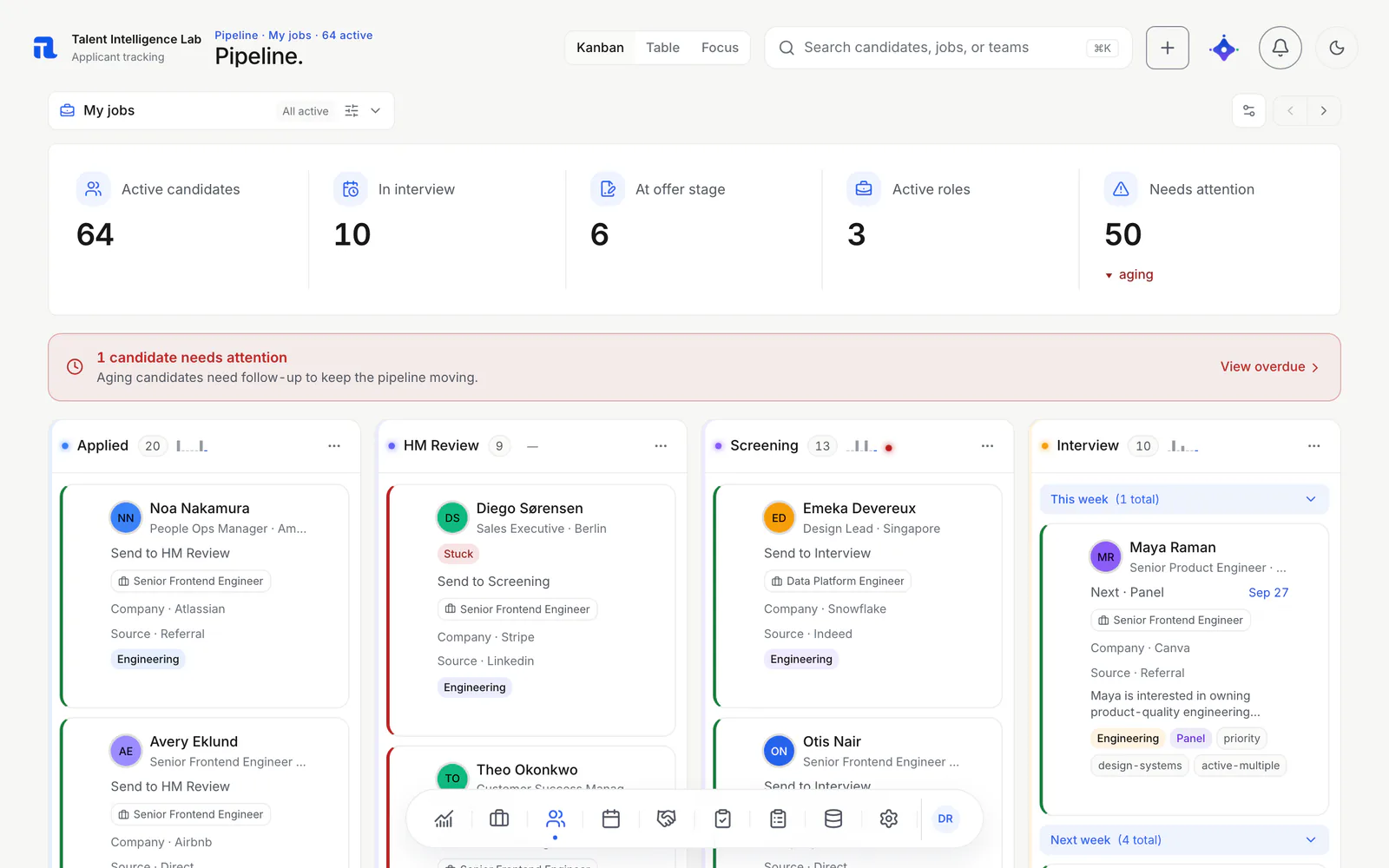
TiLab pipeline, captured September 2026 from a synthetic demo workspace. Names, companies and totals are illustrative, not customer results.
01
Agree what each person contributes
The manager writes the requirements; the recruiter owns applications and communication. Set a feedback deadline that suits your team, and confirm that your plan gives each person access to the required tasks.
02
Run one interview handoff
Use a synthetic candidate and a short scheduling exercise. Record the specific evidence, uncertainties, and recommendation against each criterion. A numerical score without supporting notes is incomplete.
03
Close the loop
The manager’s recommendation and its rationale go on the application record; the recruiter then records the decision and the next communication or offer action. Ask both people to explain the latest status without reconstructing a separate message thread.
Adopt the process only when the people, access, criteria, and handoff all work together. If a required collaborator cannot complete the task, record that as an adoption gap and resolve it before rollout.
By TiLab product team · Updated September 25, 2026. Examples use fictional roles and applicants.
Explore the workflow
Continue with a related guide.
Bring your current stages, interview criteria, and collaborator model to a product conversation, or compare the plans: Free is available now, and Basic and Growth are coming soon.